
By Jackie Senior, 13 November 2025

Given the recent developments in AI, I carried out a survey to discover how SENSE members view generative AI tools, the changes in their language work, and their future. The survey was carried out online in February-March 2025.
1. Survey results
Demographics
- There were 79 anonymous responses (33% of SENSE members), with expertise spread across the SENSE spectrum (editing, translation, teaching, copywriting, transcreation, etc.).
- 86% of respondents have been language professionals for more than 10 years.
- The data confirmed that SENSE is an ageing society, with 53% of respondents older than 60 years and 42% between 40 and 60 years (as compared to 30% and 59% in a SENSE survey in 2014). In the free text responses (49/79), 15% of respondents said they were already receiving a pension or would be soon.
Generative AI: use and perceptions
- Most respondents (86%) already use older tools like DeepL, Google Translate, SDL Trados, MemoQ or PerfectIt, either frequently or some of the time.
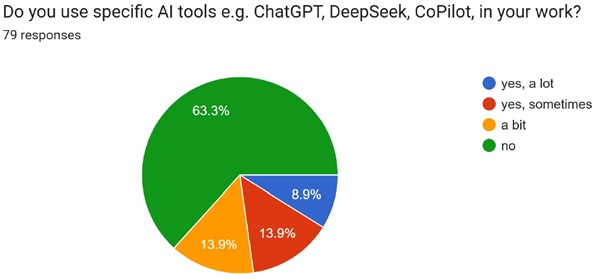
- The majority of respondents (63%) reported not using generative AI tools in their work, although 9% reported using them ‘a lot’.
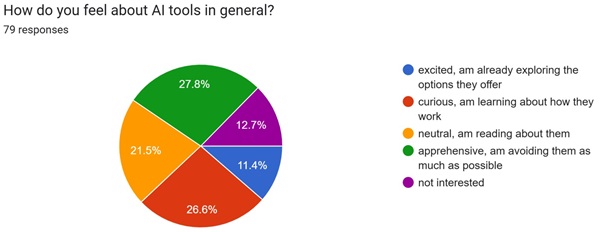
- Respondents more often reported negative feelings about what AI would bring to their profession (41% apprehensive; 17% pessimistic), with only 16% being optimistic/fairly positive.
- Only 17% reported having been asked to use generative AI tools by a client, publisher or agency. I did not enquire whether they had actually used generative AI for that particular job.
- How responders feel about generative AI was quite evenly split: 11% were excited, 27% interested, 21% neutral, 28% apprehensive and 13% not interested.
- 74% reported using these tools for personal tasks at least sometimes.
The changing ‘work-scape'
- 66% of respondents had had increased their range of language-based work in the last 5 years, and 77% had added a completely different kind of service.
- 30% have other interests/skills they could develop (into a service or money-earner), or a plan B, while another 42% reported they may have other options.
- 40% were the sole earner in their household, 38% a shared earner, and 23% a minor earner. 54% had other sources of income outside their language services (e.g. pension).
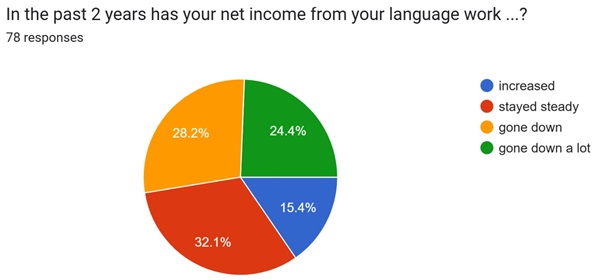
- Slightly more than half (52%) have seen a drop in income from their language work in the past two years.
Statistical analysis
- There seems to be a relatively small group who have a positive attitude to AI and use it both at work and for personal tasks, and a larger group who are neutral or negative and not using AI at all.
- No significant correlation was found between the use of or attitude toward generative AI and the respondents’ age group, but there were very few younger (under 40 years old) respondents.
- Use of AI and feelings about it at work were largely unrelated to the kind of language work being done.
2. Implications for SENSE
- SENSE was an ageing society in 2015, and is now 10 years older, with the number of members dropping fast.
- So what do the working members want to see in their professional society?
- How relevant can SENSE be for its members in these changing times?
- How does the Society need to change – or should it just retire quietly?
- SENSE must determine its members’ age groups. (At the moment this information is no longer collected because of the new privacy law. Each member must give permission for their age to be processed in Society information.)
3. What can we do?
- Keep in mind this is not the first time the field has faced a major change in our mode of working.
- Build personal relationships with clients, keeping the human face in your work. This can be challenging for freelancers, but it is clearly something that differentiates us from machines.
- Take courses and follow resources that improve our awareness of how to use generative AI tools, and develop hands-on experience that helps us understand what they can and can’t offer.
- Be able to show clients you can work with these tools, but also that you offer skills AI tools do not have.
- Adopt better pricing strategies that reflect the changes in the field, e.g. fee per hour, valuing your time, adding administration charges, and raising rates each year.
- Build reciprocal relationships with other professional colleagues that improve both the quality and continuity of your services: someone to watch your back, share skills and take up the work that you can’t.
- Look to expand the services you offer, whether in language services (e.g. offering workshops) or in new directions.
Credits go to Kate Mc Intyre, who compiled this blog post, and to Clare Wilkinson, who did the statistical analysis of the survey results. The PowerPoint PDF from Jackie Senior’s presentation to the SENSE 35-year Jubilee Conference on 20 June 2025 is available to SENSE members in our Library. Please send any comments to Jackie (email address is in the membership directory on the SENSE website).
List of resources
- The SENSE Blog
https://www.sense-online.nl/sense-publications/blog - ‘AI in Medical Writing and Editing’ training course
Emma Nichols
https://www.aimwecourse.com/ - AI Tools Boot Camp
Avi Staiman
https://www.aclang.com/ai-bootcamp.php - Generative AI in learning, teaching and assessment
Open University (UK)
https://about.open.ac.uk/policies-and-reports/policies-and-statements/generative-ai-learning-teaching-and-assessment-ou - BBC news and reports on AI
https://www.bbc.com/innovation/artificial-intelligence - Business coaching, workshops, a blog, newsletter
Lion Translation Academy (Joachim Lépine & Ann Marie Boulanger)
https://www.liontranslationacademy.com/ - Leaving academia: becoming a freelance editor
Paulina S. Cossette
https://AcadiaEditing.com/BecomeAnEditor - How to build a global academic editing business
(podcast interview by Paulina Cossette with Marieke Krijnen)
https://www.youtube.com/watch?v=jNfzf1wkvyk - Editing synthetic text from GenAI: two exploratory case studies
Michael Farrell (2024)
http://dx.doi.org/10.13140/RG.2.2.16045.81128 - Survey on the use of GenAI by professional translators
Michael Farrell (in ‘Translating and the Computer 46’, 2024, pp 23‒34;
©AsLing, the International Society for Advancement in Language Technology
https://www.tradulex.com/varia/TC46-luxembourg2024.pdf#page=23 - Henley Business School poll of 4500 people (2025)
https://www.bbc.com/news/articles/c3rpx1rl2nlo - https://societyofauthors.org/2024/04/11/soa-survey-reveals-a-third-of-translators-and-quarter-of-illustrators-losing-work-to-ai/
- https://www.theguardian.com/technology/article/2024/sep/07/if-journalism-is-going-up-in-smoke-i-might-as-well-get-high-off-the-fumes-confessions-of-a-chatbot-helper
- https://www.theguardian.com/books/2024/nov/04/dutch-publisher-to-use-ai-to-translate-books-into-english-veen-bosch-keuning-artificial-intelligence
- https://www.theguardian.com/books/2024/apr/16/survey-finds-generative-ai-proving-major-threat-to-the-work-of-translators
- The Chartered Institute of Editing and Proofreading’s (CIEP, UK) knowledge hub has a few items on AI
https://www.ciep.uk/knowledge-hub/search-the-knowledge-hub.html?searchQuery=AI
|
Blog post by: Jackie Senior |


