

Write a blog post about the new EU payment service directive and make it entertaining, said my client. Before I could even think about the entertaining bit, I spent hours trawling through articles that all said such different things about the directive that I ended up reading the bloomin’ thing itself, or at least parts of it. If only I’d attended Stephen Johnston’s workshop ‘The impossible blog: how to write a readable blog from unreadable material’ beforehand. It was held in Den Bosch on 8 June, the day before the SENSE 2018 conference.
Make the complicated sound simple
So how do you write a readable blog about a less than thrilling topic? Well, said Stephen, it’s about the tone. That's what makes a blog a blog. Write as though you’re talking to someone, but without the ums and ers. Avoid jargon, and if you must use it, explain it. Make the complicated sound simple. Avoid words you wouldn’t use in regular speech.
Know your reader
It’s also important, said Stephen, to know who your reader is and why you’re writing for them. What do you (or your client) want the reader to do when they have read the blog? Buy your product? Find out more about your company? Contact you? Keep this in mind while researching and writing the blog.
This brought us on to the structure. Stephen had brought along some materials about a new product, ranging from a very technical proof of concept document to marketing slides. Our job was to scan the material and find three main messages, without forgetting the reader and aim of the blog. He explained that once you have these three messages you can present these together followed by the supporting material. Or you can present them as: main message, supporting material, main message, supporting material and so on.
How to start and finish
We also looked at what to say in the introduction, which is where you explain why you’re writing the blog. Then Stephen talked about ending with a ‘call to action’. This is what you want the reader to do when they finish the blog. Stephen also talked about using headings to make the post easier to scan.
A blog about writing blogs. How meta! So – I began the piece by explaining what it’s about, am writing as I talk, have made the subject matter sound simple and have three main messages followed by supporting material. All that's left now is the call to action. What do I want you the reader to do? Why not improve your blog writing skills by writing for the SENSE blog? We're always looking for new input and it's a great way to spread the word about your business.
 Marianne Orchard is on the SENSE Executive Committee and an editor and writer for the SENSE blog and newsletter. She is a freelance translator (Dutch to English), editor and writer who specializes in creative texts.
Several SENSE members are speaking at the SENSE 2018 Conference. Here they reveal what they hope to achieve and what they are looking forward to at the conference.
Editing English-language doctoral theses in the Netherlands: are the SENSE Guidelines useful?
 Joy Burrough-Boenisch: ‘In my presentation I dig deeper into the situation that contributed to SENSE setting up the Guidelines for Proofreading Student Texts to explore why – unlike universities in anglophone countries such as the UK and Australia – Dutch universities seem unconcerned about the ethics of editing PhD work.
'I’ll suggest how we editors can respond. I secretly hope that awareness of the issues raised in this presentation will ripple out beyond SENSE and create waves in Dutch academia that will ultimately result in acknowledgement of the need for guidelines and transparency about the editing of student texts in the Netherlands.
‘I’m particularly looking forward to hearing Nigel Harwood’s presentation at the conference, as he’s done thorough empirical research on what “proofreaders” in the UK do to a student text and why. His findings will help us put our own work and approach here in the Netherlands into context.’
 Dealing with Dunglish – and other source-language interference
Lloyd Bingham: ‘I’m delighted to be attending a SENSE conference for the first time, more so because of this year’s theme: Englishes now! As translators into English, we need to be conscious of the varieties of English that our target audiences speak and we need to write accordingly.
‘My presentation will examine the hybrid language that is Dunglish and the problems it poses for translators. Dunglish is traditionally understood to mean English words borrowed by Dutch that retain the same meaning. Modern Dunglish, however, is also about borrowing words and phrases that might look English and sound English…but English they ain’t. Cue translators pulling their hair out, trying to get to the bottom of what a Dunglish phrase actually means. After all, there are no Dunglish dictionaries! So my presentation will propose some techniques to translate Dunglish into English that natives can understand.
‘Looking forward to seeing you there!'
 Disrupting the inheritance of poor writing habits: an alternative approach to editing and teaching writing (in the health-related sciences)
Charles Frink: ‘The main goal of my presentation is to provide a glimpse of the underlying scientific structure in biomedical manuscripts. A narrow linguistic approach to writing and editing is often ineffective if the core scientific elements of a biomedical manuscript are not explicitly present and logically linked. The document may still lack the elusive “flow” that is so highly prized by peer reviewers and journal editors.
'My proposition is that mastering this structure will empower young scientists to disrupt the inheritance of poor writing habits from their supervisors, professors and senior co-authors.
‘I am especially looking forward to Valerie Matarese's presentation on bad textual mentors and the panel discussion on language versus subject specialists in biomedical editing and translation.’
 Identifying and rectifying translatorese
Marcel Lemmens: ‘Some literal translations are fine and others are awkward. The awkward ones are often examples of translatorese. Being able to distinguish between the two makes you a better and more efficient editor. That is the message we would like to get across.’
 Tony Parr: ‘Among the points we’ll be looking at are “the curse of knowledge” and “translator’s privilege”. So what have these got to do with translatorese and why should we as translators be wary of them? To find out, join us at 9.30 on Sunday morning on 10 June (gulp)!’
 International science needs English editors
Jackie Senior: ‘I hope to show that it is well worth specializing in science editing if you’re looking for a niche. I’m particularly looking forward to meeting the international delegates at the conference and hoping they will set SENSE members thinking about the Dutch versus the European situation.’
 '... divided by a common language': cultural, topical and geographical Englishes
Nigel Saych: ‘I’m looking forward to discussing with people attending my presentation how the English we used in the past differs from that in use today, and what we may have to concern ourselves with as linguists in the future. My only regret is that I can’t attend the other sessions that are on at the same time!’
 Outreach and research communication in English: opportunities for language professionals
Maria Sherwood-Smith: ‘What I would like to achieve with my presentation is to sound people out on what I think may be a trend towards a more central role for communication skills in the research process and what implications this may have for language professionals. And as a first-time presenter, I suppose my other aim is to take another step along the path towards becoming that mythical “language professional”, as opposed to merely the full-time language amateur I usually feel I am.
‘As for other presentations, I’m especially looking forward to Jeremy Gardner's talk on EU English, Nigel Harwood on editing Master’s theses and Jackie Senior on science editing. I am particularly sorry to be missing the panel discussion on the Dutch guidelines for editing PhD theses in an international context, which is at the same time as my own presentation. I found it very difficult in general to choose between all the tempting parallel sessions...’
The day before the SENSE 2018 Conference, John Linnegar is giving a workshop entitled ‘It needs only a “light” edit': negotiating the differences between light, medium and heavy editing. We caught up with him to find out more.
How do you feel about giving a pre-conference workshop?
Very enthusiastic, for two reasons: first, I believe that such workshops (certainly most of those I’ve attended) offer great value to attendees – we always come away with worthwhile and practical knowledge and skills, even if they only refresh our current thinking and practice. Second, the topic I’ll be covering strikes many a chord among editors – many are searching for the answer to the question of how we distinguish between the different levels of editing. I myself learnt the answer relatively late in my career as an editor! Now I want to share my discovery with my colleagues, because I know how much it has helped me with editing and quoting.
What do you hope participants will take away from the workshop?
A clearer understanding of the differences between the three levels of editing (heavy, medium and light), and of the criteria used to distinguish one from the other. I’ve also developed a little ‘formula’ for measuring the differences, which I’ll be sharing with the participants.
Are you attending the conference itself?
Yes, and I’m looking forward to it! I’m on the organizing team, too. And besides the workshop, I’ll be presenting a brief session on Garner’s Modern English Usage (OUP 2016). I believe it to be a gem of a reference work for (English) language practitioners. It’s an admirably modern update to Fowler’s Modern English Usage, and displays wonderful inclusivity and balance in dealing with American and British English.
Is this the first SENSE conference you’ve attended?
No, I had the privilege and pleasure of attending the 2015 Jubilee Conference, shortly after I joined SENSE. That was a great professional gathering and information-sharing experience that I was concerned should not be allowed to remain a one-off. After all, other societies in Europe hold annual conferences...
What are you looking forward to most?
First, the two keynote speakers, speaking on topics of great interest to all of us. Then, the camaraderie engendered by a meeting of minds from all over Europe (11 countries). Recently, I’ve become particularly interested in how the quality of translations is evaluated, so I’m keen to hear what a researcher in the field – Dr Iris Schrijver, from the University of Antwerp – will have to say about this controversial topic.
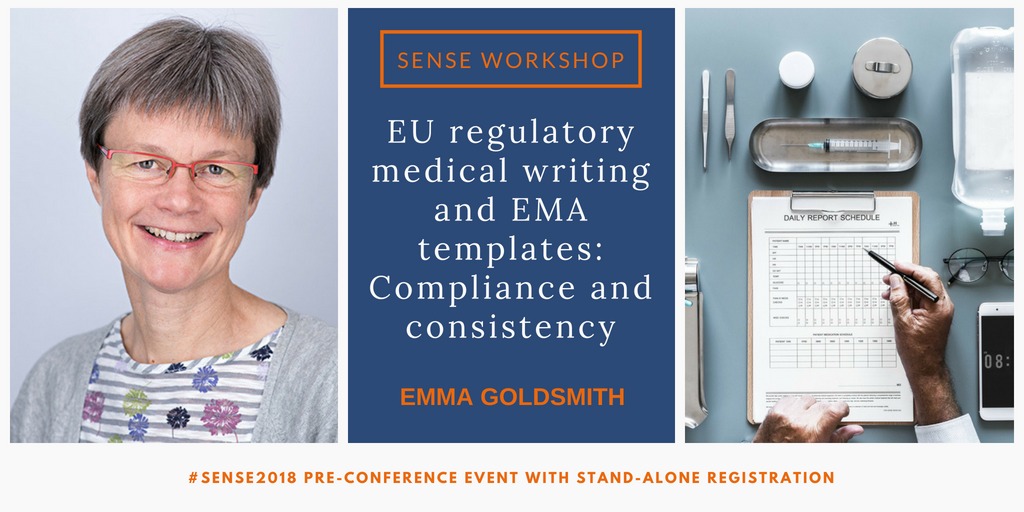
Emma Goldsmith is travelling from Spain to give a workshop entitled 'EU regulatory medical writing and EMA templates: compliance and consistency' the day before the SENSE 2018 Conference. We caught up with her to find out more
‘I’m the sort of person who loves to follow rules,’ says Emma. ‘Give me a style guide and I’ll read it from cover to cover. Give me a deadline and I won’t be late. That explains why I feel so at home with EMA templates and the strict terminology, quick turnaround times and detailed guidance documents that go with them.’
If, like Emma, you love rules and are a translator who works with European languages, then this workshop is for you. You will learn about, or refresh your knowledge of, EU regulatory medical writing in general and EMA (European Medicines Agency) templates in particular.
‘My goal is to share my enthusiasm for EMA templates with workshop attendees,’ says Emma.
Emma is a Spanish to English translator who specializes in medicine. She has over 20 years’ experience translating clinical trial documentation, articles for publication in medical journals, and product information for EMA submissions. She trained and worked as a nurse before becoming a translator.
The workshop is on Friday 8 June from 14.00 to 17.30, the day before the SENSE 2018 conference. It will take place at the conference venue, Hotel Central in the Dutch city of ’s-Hertogenbosch.
Emma is travelling from Spain to give the workshop. Will she be attending the conference while she’s there?
‘Absolutely,’ she says. ’I’m particularly looking forward to the contrasting talks on well and poorly-written texts by Charles Frink and Valerie Matarese. I’ve also got my eye on the Saturday morning guided tour of 's-Hertogenbosch and I’m only sorry that my early Ryanair flight on Sunday afternoon means that I’ll miss the boat trip!’
Is this her first SENSE conference?
‘This will be the first SENSE conference I’ve attended and in fact the first time I set foot in the Netherlands. So I’m looking forward to it for many different reasons: meeting old friends, making new ones and getting to know a new country, language and culture, albeit in just 72 hours!’
So if you fancy following some rules and want to learn all about the not-so-wild world of regulatory medical writing, sign up for the workshop. (Don’t forget to log in first if you’re a SENSE member).
 As a scientific language editor, I often need to browse articles when editing. But without a university/institute subscription, getting free access to the literature can be tricky.
Although the number of open-access journals is increasing, many articles are still locked behind ‘paywalls’. This means that to read the full text of a particular article, you have to purchase it, or subscribe to the journal for a hefty fee. I doubt my clients will accept that add-on cost.
But free versions of paywalled articles are sometimes available, for example if the author has uploaded it elsewhere. Impactstory is a non-profit open-source, web-based service committed to making research data freely available to all. In April last year, they introduced Unpaywall, a web browser extension that can retrieve open-access articles immediately and automatically. For free.
Unpaywall can be installed into Google Chrome or Mozilla Firefox browsers. It takes seconds and you don’t even have to restart your computer. It works automatically, while you browse, so no need to insert the article’s DOI into a search box. And don’t worry: Unpaywall only retrieves articles from legal sources.
It’s pretty user friendly. A few seconds after finding an article, an Unpaywall symbol will appear at the side of your screen. If an open-access version of this article is available elsewhere, a green unlock symbol will appear. Clicking on this symbol allows you to read it for free. A grey lock symbol tells you that no open-access version was found. Unpaywall finds a free version at least 50% of the time, which makes life a little easier (and cheaper) for the self-employed language editor.
 Claire Bacon is an editor and writer for the SENSE blog and a research scientist turned editor who runs a business called Bacon Editing.
 After seeing GDPR and AVG abbreviations popping up all over the place – in emails from Google, from the freelancers’ platform PZO, and on social media – and with 25 May fast approaching, and having missed SENSE’s January workshop on data privacy and information security, I thought I’d better take a look at what all the commotion was about. Read on to find out what I dug up and how it applies to freelancers.
What is the GDPR?
The General Data Protection Regulation – or Algemene verordening gegevensbescherming (AVG) as it’s known here in the Netherlands – will soon come into force across the EU. It’s basically a privacy law that tightens up the rules on providing third parties with our data, so that we know what will be done with it and why before we give our willing consent. The new laws are relevant to both our professional and personal lives, as Marianne Orchard indicates in her review of John Yonce’s data privacy workshop: ‘professional because we must protect any personal data of others that we have access to and personal because we should protect our own data.’
For a perfect example of why such a regulation is needed, we need look no further than the Facebook–Cambridge Analytica data scandal, in which the data of millions of Facebook users was handed over to a political consulting firm without those users’ knowledge or permission.
Of course, it’s easy to say, ‘Well what do you expect if you’re on Facebook?’ But even if you’re aware of their business model – ie, that the advertisers are the real clients and you are just the product – most Facebook users, myself included, have not been persuaded to delete their accounts. Naive it may be, but we assume that companies use our data respectfully and comply with what regulations are in place, for the simple reason that we can no longer do without the plethora of apps and websites at our fingertips.
After all, how else do we keep up with friends and families in other countries and with our kids’ online activities, not to mention our professional networks? How else do we comply with requests for information from our clients, agencies and business contacts? Whether moving house, writing a will, buying insurance, joining a professional association, enrolling at a new translation agency or using our clients’ complicated billing systems, we are continuously filling in our personal data online.
When will it be enforced and to whom does it apply?
The GDPR comes into effect on 25 May 2018 throughout the EU, from which point any large companies found to be in breach can expect large fines. Great news for consumers as it means greater protection of our personal data, including sensitive information such as religion, racial or ethnic origin, political opinions, religious or philosophical beliefs, trade union membership, genetic data, biometric data, data concerning health or data concerning a natural person’s sexual life or sexual orientation.
According to this website for small businesses, the GDPR applies to any business that processes the personal data of EU citizens. This includes customer, supplier, partner and employee personal data. In addition, companies processing data that have more than 250 employees, or for whom processing data is a core activity, must appoint a Data Protection Officer or DPO – someone up to date on data protection practices and the legal framework and who is responsible for ensuring that unambiguous consent is obtained from ‘data subjects’, i.e. EU consumers and citizens.
What do freelancers need to do about it?
Naturally, freelancers are way below the threshold of 250 employees. And another nugget of information I found on this website for startups is the following: ‘The Regulation only applies to personal data if it is processed wholly or partly by automated means or is part of a sophisticated hard copy filing system.’ Aha! – nothing to do with me as I’m not processing data.
But does this mean that I can ignore it entirely? I’m still in two minds. My gut feeling and pure logic says no: I have no automated mailing list for sending round emails to clients or business contacts. I have no form on my website for people to get in touch. The only personal data I have of clients that is not already publicly available is the data the tax office requires that I put on my invoices. Some clients ask me to address the invoice to their private address, and some clients’ business and home addresses are the same. Colleagues to whom I sometimes outsource work also give me personal data in their emails and invoices. But who is going to be bothered about me having that data on my computer? Surely I can’t run my business without it?
But on the other hand, regardless of whether or not the risk of a fine is minuscule, it’s no bad thing to think about what data on other people I have on my computer and how it is protected, right? I found more information on how freelancers can prepare for the GDPR on this website of a collective of freelancers in healthcare communications.
Is there anything in particular that editors, translators or copywriters should consider?
When I put this question to the SENSE members forum, several people confirmed my initial gut feeling that this does not apply to freelancers. But others are not so sure. What about personal information in medical, legal or HR-related files that we edit or translate? From my days as a medical translator I remember one particular agency that rarely took the trouble to remove personal information from the texts they sent me, which was clearly in breach of privacy legislation.
In this respect, it seems I need a privacy notice, available on demand or downloadable from my website. This is a public statement of how a company – whatever its size – applies data protection principles to processing data. And I assume this applies to personal data that clients and colleagues provide me by email. The privacy notice tells them what I’m going to do with any information they provide. Fair enough.
Fellow SENSE member and translator Robert Bradley recently had a privacy statement drawn up. He says:
To me, it's worth it, and I suspect it might be for quite a lot of translators: not so much because people might start demanding to see what data we have on file, but because we have clients who are subject to the stricter rules and who need to demonstrate compliance. That means that they need confirmation from their suppliers (that's you and me) that everything's sorted out. I'd rather not lose any clients over this.
Meanwhile, over on good old Facebook, a translator based in the Czech Repubic (or Czechia if you prefer) has set up a group called GDPR for Translators (you’ll need to log in first) which has plenty of discussions on the topic, plus resources and tips for both agencies and translators who want to make sure they are GDPR-compliant. There are questions and answers on topics such as deleting old emails and email addresses, cloud storage, websites and privacy statements.
So what is SENSE doing about the GDPR?
Clearly, SENSE as an organization also needs to be on the case with regard to the personal data it collects from members. But more about this in a follow-up post!
Feel free to post your comments below or get in touch to share your experiences with the GDPR.
Sally Hill is an editor and writer for the SENSE blog and newsletter and a British biologist-turned-linguist who runs a business called Scientific Texts.
 Sometimes you come home from a workshop thinking how useful it was and how you’ll definitely do everything the trainer suggested… when you find the time.
Sometimes you dash straight to your PC.
The latter was certainly the case after John Yonce’s immensely useful Data Privacy and Information Security workshop. By the time the kids had surfaced on Sunday morning, I’d installed two new browsers, tried out a new non-spying search engine, looked at what my virus scanner did on the malware front, installed an ad blocker, reviewed my backup process and configured the password vault I’d recently started using. (And made a checklist of all of this and checked off each item as I completed it.)
Most of us at the workshop were attending because we’d heard about the EU’s new General Data Protection Regulation (GDPR) and this seemed like an easy way to find out what we needed to do. We were working as translators, copywriters, editors, subtitlers and interpreters.
John began by looking at the origins of privacy and how it has a cultural context: in some cultures you don’t talk about your salary, for instance, whereas in others it’s fine. The modern concept of privacy dates to 1890 Supreme Court Justice Louis Brandeis and Samuel D. Warren talking about ‘the right to be let alone.’
We then looked at current privacy laws in the Netherlands and Europe and the GDPR in particular. This was relevant to our professional and personal lives: professional because we must protect any personal data of others that we have access to and personal because we should protect our own data.
The next step was to look at possible threats to privacy and information, and measures to prevent these. This means virus scanners, firewalls, ad blockers, malware blockers, updates and so on.
It also means general awareness of what data you’re sharing with whom when you install an app, create an account or hand over a copy of your passport, and whether you want to share this data at all. And a whole lot more, because there’s a lot of bad eggs out there waiting to get their hands on your data.
SENSE workshops tend to be bastions of niceness with lots of tip sharing and empathising. This stood out against the skulduggery and menace of data theft. But perhaps skuldugs are also charming to each other at skulduggery workshops and travel home together on the train discussing words for sprinkles (chocolate vermicelli, nonpareil, hundreds and thousands…), why coriander is cilantro in US English and how they need crocheted bootees for their sofa legs because they keep stubbing their toes on them. Who knows?
Marianne Orchard is on the SENSE Executive Committee and an editor and writer for the SENSE blog and newsletter. She is a freelance translator (Dutch to English), editor and writer who specializes in creative texts.
 The more editors I meet, the more I realise that many of us fall into the profession by ‘accident’. I certainly did not set out to become an editor – my background is in neuroscience and human genetics and I thought I would wind up being a professor with my own research lab.
But three years after leaving research, I am the proud owner of an editing business that is doing pretty well and I love my work. Changing career path can be pretty daunting. Sometimes it helps to hear what people in the same boat have to say. In this article, I share what I have learned in the last three years.
Finding work
Starting out as a freelancer, the big question on my mind was: where will I find work? As a native English speaker working in a German lab, I had been editing papers for my colleagues for years so already had a handful of clients. But I didn’t have enough work lined up to pay the bills.
To ensure a reliable source of income, I joined an editing agency. They sent me regular assignments and although the editing rates were not great, I was gaining valuable experience, earning some money, and was free from the pressures of self-marketing.
However, I realised that the client can learn a lot more from the editing process when he/she has direct contact with the editor. So after a while, I decided to take the leap, quit agency work, and invest time in building up my own business: Bacon Editing.
Online presence and content marketing
Most people search the Internet for products and services, so I created a website for Bacon Editing. At the SENSE Professional Development Day last September, Theresa Truax-Gischler talked about how to build your content marketing strategy around a hub-and-spokes model.
The spokes (Facebook, Twitter, LinkedIn, etc.) can all be used to drive traffic to the hub (your business website). I began to use my Facebook and LinkedIn accounts to share content and promote my business.
To enhance my marketing efforts, I started to write a blog. A good blog needs a defined niche and target audience. I edit pre-submission research papers for ESL scientists and clinicians and was coming across the same issues again and again with my clients’ writing. I decided that my blog posts would tackle these common problems.
Writing a blog has promoted my business. Sharing my articles on social media drives people to my website and connects me with other editors. It also gives me a reason to touch base with my existing clients; each month, I email them my blog articles and usually get a job or two in return.
Training and mentoring
Nobody is too talented to learn more. I have the necessary scientific expertise to understand my clients’ work but I was no grammar expert when I started editing.
To strengthen my profile as a language editor, I took an online editing course. Professional training is not essential for freelance editing, but most experienced editors strongly recommend it. The editing course was a good choice for me; it gave me the knowledge I needed to explain and justify my corrections to clients and motivated me to continue with more advanced courses.
One of the best ways to learn how to build a successful editing business is to talk to people who already have a successful editing business. Curtis Barrett took time out of his busy schedule at the SENSE Jubilee conference in 2015 to explain how he made a success of English Editing Solutions in just a few years.
One valuable piece of advice was to have confidence in your abilities as an editor and not compromise on your rates. Curtis encouraged me to quit agency work and go after clients who are willing to pay the fees I deserve, which was definitely a push in the right direction.
If you are very lucky, you will connect with someone who is prepared to invest considerable time in your success. I met Ragini Werner (owner of NEEDSer and former eSense editor) at the SENSE Jubilee conference and she has gone above and beyond to help me become a better editor and writer.
Ragini checked through several of my completed edits, encouraged me to write for eSense, gave feedback on my website, and provided invaluable support when I set up my blog. She also trusted me enough to leave her clients in my hands while she recovered from knee surgery earlier this year.
This mentor-mentee relationship has boosted my professional development and I am extremely thankful to have Ragini on hand to offer advice. That’s what networking can do for you.
It’s all about networking
We all know that networking is one of the best ways to find clients. That’s why we join societies, go to conferences, and participate in online forums. Sally Hill talked in depth about the hidden value of your personal network at the Professional Development Day last year.
‘Prepare a few choice phrases about who you are and what you do,’ Sally told me over lunch, ‘then you will be able to give a good answer when people ask about your work in social situations’.
This was excellent advice, particularly because I have most of these conversations in German (my second language). After Sally’s talk, I decided to explore my personal network a little more.
At the playground, I started to talk to other mums about my work instead of just teething problems and tantrums. I live in Heidelberg, one of the top research cities in Germany, and it occurred to me that some of the mothers building sandcastles and wiping snotty noses could be research scientists on maternity leave, or know people who work in research.
Sure enough, I gained two regular clients from chatting to mums. I also exploited my husband’s connections as a maxillofacial surgeon to get work (now he always attends conferences with a pile of my business cards). As Sally promised, capitalizing on my personal network was a great way to generate business.
A local professional network – people you can meet with face-to-face to discuss work-related issues – is also important, particularly if you work from home. I met some fellow language professionals at a networking event run by the Heidelberg International Professional Women’s Forum, and initiated an informal language meet-up.
Our small group now includes editors, translators, interpreters, and teachers and we meet up regularly for informal work-related discussions and to share our services.
The road to success
Starting a business from scratch may seem daunting at first. Hopefully, some of the tips outlined in this article will help you make the jump from beginner to successful entrepreneur.
Claire Bacon is an editor and writer for the SENSE blog and a research scientist turned editor who runs a business called Bacon Editing.
 At the recent AGM, SENSE's Executive Committee (EC) installed three new members, myself included. For our first meeting in mid-April, we got together for a 'team building and website training day.' For me, the standout moment of the day was an animated discussion on how to chop a pepper. It embodied what teamwork is and illustrated why the EC needs to work as a team and how this will benefit SENSE and its members,
I'm sceptical of 'team building.' Maybe it's because my husband has herded sheep and spent hours communing with horizontal rain on Solex tours (yes, more than one) of the polder in the name of team building.
Sheep and Solexes were unlikely, but would we have to do trust exercises?
Luckily not. After learning how to hoist the SENSE flag for events (no, SENSE didn’t become a paramilitary organization when the SENSE constitution was amended last year), a round of ‘tell us a bit about yourself’ and some strategy brainstorming, it was time for the team-building proper to begin. Time to start doing rather than talking.
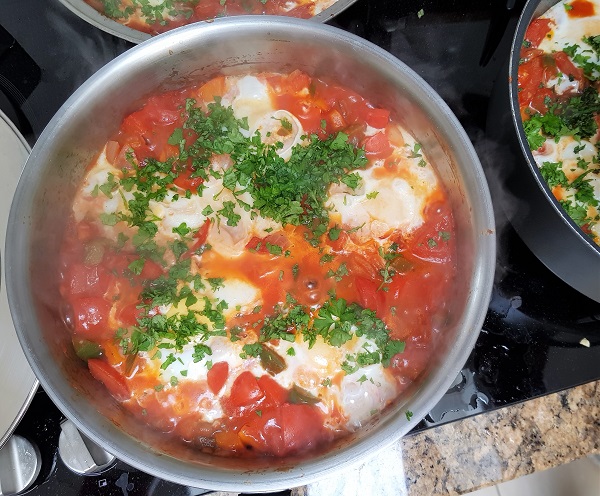
Jenny, our acting chair, had chosen the benign ‘make lunch together’ as the activity.
Before we could make our lunch – a dish called Shakshuka – we needed to do the shopping. While three of us headed off to the Albert Heijn at the end of the road, the others started chopping onions, in anticipation of the arrival of the other ingredients.
Yay, we’d allocated tasks. We were working as a team already!
But niggles emerge when you work with others. Wasn’t that too much oil in the pan? Wasn’t the flame too high? Wouldn’t it be better to crack the eggs into bowls first?
As mother of a teen and a tween, I’m learning it’s often best to keep your big mouth shut. Or in the words of the great oracle Ronan Keating, ‘You say it best when you say nothing at all.’ I’d assumed this worked best for teams too. Just let people get on with their oil-dispensing, onion-chopping, egg-cracking madness. Things should work out in the end.
But that was before the pepper discussion. The pepper revelation. As two of the EC chopped peppers they noticed they were using different pepper-chopping strategies! And started discussing them. And wondering if the other strategy might work better.
This is what teamwork is. It’s alright to comment on how people do things. But you have to pitch it right. And if you’re on the receiving end you need to be open to doing things differently.
Will the pepper revelation be emblematic of this EC? Will we be the Order of the Capsicum?
Will we discuss how to do our tasks? Will we offer and be open to suggestions? Let’s hope that this constructive and gezellige day bodes well for the future.
Marianne Orchard is on the SENSE EC and writes and edits the SENSE blog and newsletter. She is a freelance translator (Dutch to English), editor and writer who specializes in creative texts.
The SENSE 2018 Conference is approaching fast and you may be curious about what's going to be on offer. We therefore caught up with Stephen Johnston, who is giving the pre-conference workshop entitled 'The impossible blog: How to write a readable blog from unreadable material.' It’s all about the hook, he says.

Ever been asked to write an entertaining piece about EU legislation, a new pension plan or the latest innovation in grout? Then this workshop is for you.
Or perhaps you just want to learn how to turn drab into fab, sigh into wry, yawn into… prawn?
‘It’s all about looking at the source material and finding an interesting hook,’ says Stephen. ‘This will most likely end up being the title, intended to catch the reader’s eye. The hook then informs the rest of the blog.’
And what will participants take away from the workshop?
‘The ability to turn dry, overly-granular information into an interesting, easy-to-read blog,’ he says.
Stephen is a professional trainer, copywriter and journalist who works with multinational companies on projects such as websites, internal and external communication, white papers, marketing material, brochures, corporate journalism, speechwriting... and blogs.
The blog workshop is one of four pre-conference workshops. How does Stephen feel about giving the workshop?
‘Delighted. It will be a great way to warm up to the event with a fun, interactive (and hopefully skill-delivering) few hours.’
And is he attending the conference itself?
‘Yes! I have attended a lot of SENSE events, but this will be my first conference. I’m looking forward to the mix of speakers and the opportunity to catch up with colleagues.’
The SENSE 2018 conference is on Saturday 9 and Sunday 10 June. But there’s also a range of pre-conference workshops and sightseeing activities. So even if you can’t make it to the conference itself, you can still join in.
The workshops will be held on Friday 8 June from 14:00 to 17:30 at Hotel Central in ’s-Hertogenbosch, the conference hotel. They are open to SENSE members and non-members alike. Various fees apply.
So if you want to find out why hooks are as important to writers as they are to shepherds or pirates, go to the registration page and sign up for Stephen’s workshop. (Don't forget to login first if you're a SENSE member.) But hurry because places are limited!


