By Joanna Bouma, 25 November 2026
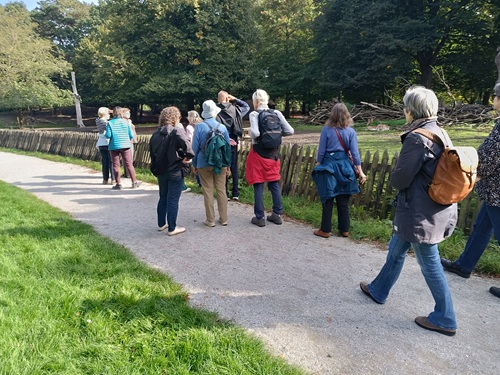
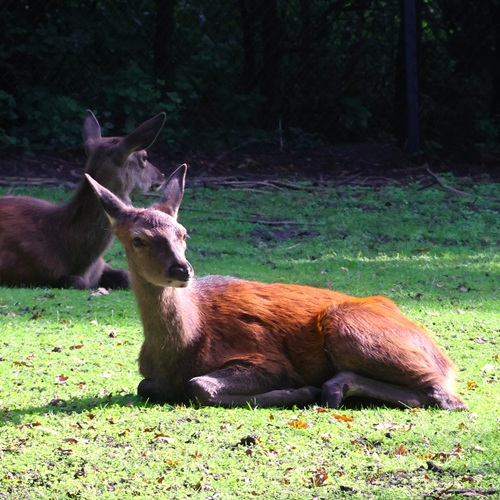
This time the SENSE autumn social was a little different. Instead of visiting lovely historic towns, going on boat trips etc., we went for a walk in the beautiful and historic Haagse Bos, close to The Hague’s city centre. Living close to the Haagse Bos and knowing it like the back of my hand, I was asked to lead the group and talk about its history and nature. On the afternoon of Saturday 3 October, we met up at the Paviljoen Malieveld restaurant on the Malieveld field that is part of the Haagse Bos, the oldest protected woods in Western Europe. From there, we walked to the Koekamp to see the two species of deer that are kept there, the fallow deer and the red deer. They can sometimes be hard to spot if they are among the trees away from the footpath. While it was the red deer rutting season, we didn’t hear any of the red deer roar though we did see a couple of males locking antlers.
 Walking on from the Malieveld we headed for the woods, stopping briefly to look at an underground wildlife crossing that a lot of people assume is a gutter. It is used by frogs and toads to safely cross the road from one body of water to another, and by mammals like mice, hedgehogs and even pine martens.
We walked on and looked at a famous tree with a swastika high up on the trunk. Why was there a swastika? The Haagse Bos was an important strategic location in World War Two during the occupation of the Netherlands by Germany. While the occupying forces felled almost all the trees in one large section of the woods, they left a few standing which were used as lookout posts by soldiers on watch for allied aircraft. One soldier on watch carved the swastika into the trunk and naturally it has remained there ever since. It is hard to spot among all the branches and leaves, but once you see it the war stories come to life.
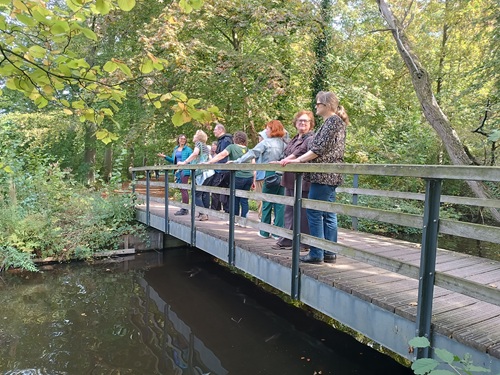 Close by is a pond in an open grass field. It is open because the German forces cut down the trees to make an open space from which to shoot their V2 rockets to bomb London. This field and the SS Headquarters in the Clingendael woods not far away were thus prime targets for the Allied forces. On 3 March 1945 the British Airforce tried to bomb the V2 rockets, but made a terrible mistake with the coordinates. Heavy mist also meant that the pilots could not see where they were dropping the bombs. Instead of bombing the field with the V2s, they bombed a whole residential neighbourhood, killing well over 500 people. Last year, a 50-minute film called ‘Bezuidenhout’ was released about the accidental bombing. The cast includes departing SENSE member Francis Cox, who plays a British spymaster. You can watch the trailer here.
Despite the poverty caused by the war, when the war ended, hundreds of residents, many homeless, jobless and having lost loved ones, planted trees in the area felled by the occupying forces. This kind and caring act meant that the protected Haagse Bos became a sea of green again. However, as the funds and availability of saplings were so limited, only two or three species of trees were planted, exacerbating the woods’ loss of biodiversity caused by the war. The National Forest Service (Staatsbosbeheer) is working on thinning the dense vegetation to bring more light to the ground, and replacing sick and dying trees with different tree species to enhance the biodiversity.
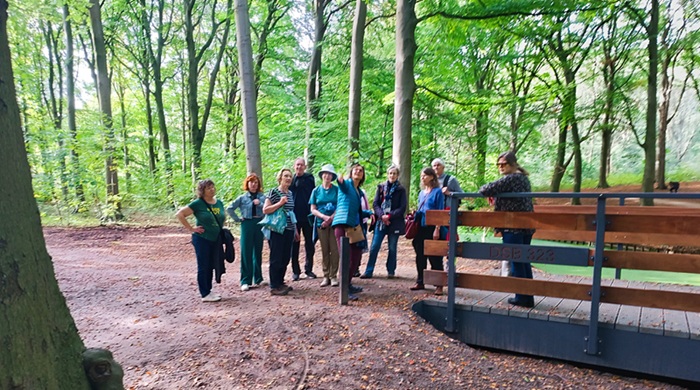 Leaving World War Two behind, we walked on, enjoying the trees and plants. We were now in the part of the woods that had not been felled, so could get an idea of what the Haagse Bos was like when it was protected in the Akte van Redemptie in 1576. We briefly stopped at Huis ten Bosch, the royal palace. Unfortunately the King and Queen were not at home for a cup of tea, so we walked on.
Looping back towards the Malieveld, we strolled through the older part of the woods. We passed another wildlife crossing, this time a controversial long narrow bridge across the busy A44 road. It was originally built in 2012 for squirrels to safely cross over from the Haagse Bos to repopulate other parks and green areas. The controversy was that it was very expensive to build and was barely used for a few years. But we know that wild animals need time to explore new things and, if they feel safe, will then use them. We also know that squirrels hibernate so they won’t use the bridge in winter anyway. But the bridge is now being used, particularly by pine martens. Since then, two rope bridges have been strung across two parts of the Haagse Bos intersected by the busy Laan van Nieuw Oost Indie.
It’s hard to spot wildlife in an urban forest, during the day in a group of people, and with other walkers and cyclists around. But walking here regularly and at different times of the day with my dog, I have seen three species of bats, buzzards, cormorants, foxes, hawks, hedgehogs, herons, kingfishers, mice, moles, owls and owlets, a red deer and her calf, rabbits, shrews, woodcock, voles and more. A buzzard even once dropped a dead baby rabbit on my head and then perched on a branch and glared at me like it was my fault. Unfortunately, the rabbit population all over Europe has been decimated by a disease. I can’t remember what it’s called but it was not myxomatosis. And a bit further on, where we did not have the time to walk, there are some open fields where I’ve seen storks and egrets too.
I am blessed to have the Haagse Bos practically on my doorstep and was so happy to lead a group of SENSE members through the woods and share some of what I have learned about both its history and its biodiversity.
Note: Many thanks to Samuel Murray and Helen van Oosten for the beautiful photos.
|
Blog post by: Joanna Bouma |